
Download DC Civil Rights Tour App


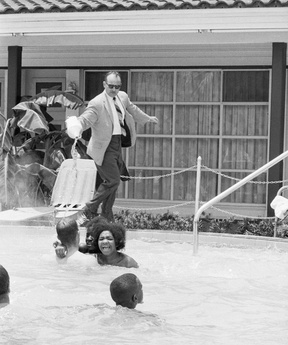
By 1964, St. Augustine, Florida had become one of the most intense battlegrounds of the civil rights movement, with local activist Dr. Robert Hayling organizing sit-ins and protests that eventually drew in Dr. Martin Luther King Jr. and the Southern Christian Leadership Conference. On June 11, King himself was arrested after trying to eat at the Monson Motor Lodge's segregated restaurant. A week later, on June 18, activists escalated their tactics with a "swim-in": a group of Black and white protesters jumped together into the motel's whites-only swimming pool while a group of rabbis, who'd traveled to St. Augustine to join the movement, held a prayer service in the parking lot. Motel owner James Brock, furious at the protest, poured muriatic acid into the pool water in an attempt to force the swimmers out, while an off-duty police officer jumped in fully clothed to drag protesters out and arrest them.
Photos of the moment, including one of Brock pouring the acid and another of the officer leaping into the pool, ran in newspapers around the world, putting an ugly and undeniable face on Southern segregation right as the U.S. Senate was in the final stretch of an 83-day filibuster against the Civil Rights Act. The day after the swim-in, the Senate voted to end the filibuster, clearing the way for the bill's passage, and President Lyndon Johnson signed the Civil Rights Act of 1964 into law less than two weeks later. St. Augustine businesses were slow to actually integrate even after the law passed, and the Monson itself was later firebombed by the Ku Klux Klan once Brock was legally forced to desegregate. He eventually went bankrupt, and the motel was torn down and replaced by a Hilton hotel, but the story of what happened in that pool remains one of the more visceral, hard-to-look-away-from moments that helped turn public opinion during the final days of the fight for the Civil Rights Act.

