
Download DC Civil Rights Tour App


In Tolleson, Arizona, a small farming town, the school district made kids of Mexican and Latin descent go to a separate, worse-funded "Mexican school," while white kids went to a completely different school. The district's excuse was that Mexican American students needed separate classes because of language issues, but they never even bothered to test anyone's English before sorting them into schools. Even kids who spoke perfect English got segregated anyway. In 1950, a group of parents in Tolleson decided they'd had enough and sued the school board. One of them was Porfirio Gonzales, whose daughters Gloria and Mary Ellen were stuck in the segregated school, and he argued that what the district was doing violated his kids' constitutional rights.
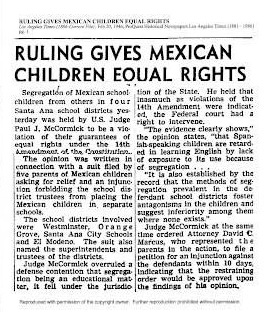
On March 26, 1951, Judge Dave Ling ruled in favor of the families, saying the segregation was unconstitutional. He pointed to a similar case that had just happened in California, Mendez v. Westminster, where the courts had struck down the same kind of segregation. What's interesting about Gonzales v. Sheely is that the judge didn't just rule on some narrow technicality — he came right out and said segregation itself was wrong, which not every court had been willing to do up to that point. This all happened three years before the Supreme Court's Brown v. Board decision in 1954, so it was actually part of the legal groundwork that helped lead to the end of school segregation across the whole country. Today, Tolleson's elementary school is named Porfirio H. Gonzales Elementary School to honor the family that fought the case, and there's a memorial marker there recognizing everyone in the community who stood up for what was right.

