
Download DC Civil Rights Tour App


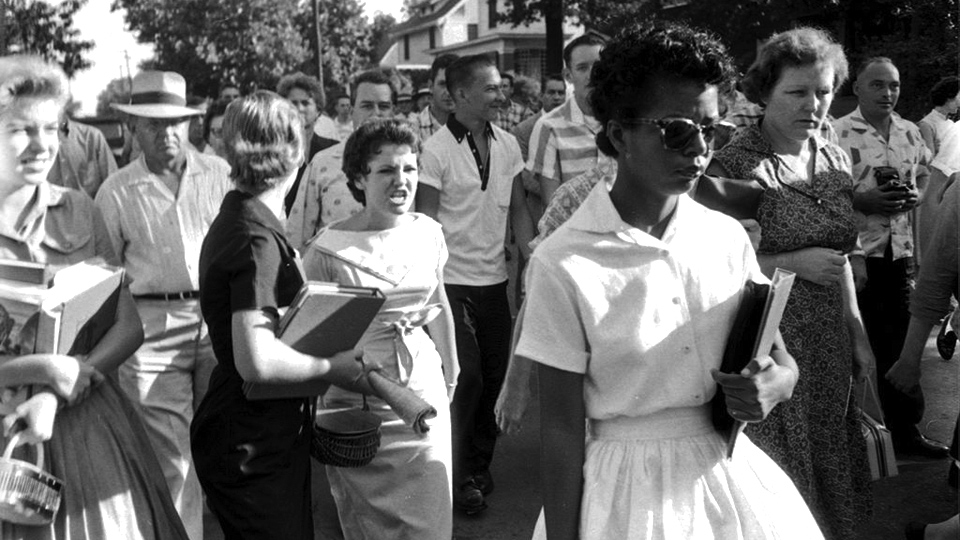
In 1957, three years after the Supreme Court's Brown v. Board of Education ruling, the Little Rock, Arkansas school board had agreed to gradually desegregate its schools, starting with Central High. Nine Black students, who came to be known as the Little Rock Nine, were selected to be the first to enroll. But on September 2, the night before school started, Governor Orval Faubus ordered the Arkansas National Guard to surround the school and block the students from entering, claiming it was to prevent violence. The next day, when the students tried to attend, one of them, fifteen-year-old Elizabeth Eckford, arrived alone after not getting word of a change in plans, and had to face an angry white mob by herself while the guardsmen refused to let her pass or protect her.
A federal judge ordered Faubus to remove the National Guard, and on September 23, the nine students tried again, sneaking in through a side door while a mob of hundreds gathered outside. School officials had to send them home out of fear for their safety. Two days later, President Dwight Eisenhower sent over a thousand paratroopers from the U.S. Army's 101st Airborne Division to escort the nine students into the school and protect them throughout the day. Even with soldiers stationed at the school, the students faced daily harassment and abuse from many of their white classmates, and it took real courage for eight of the nine to make it through the entire school year. The Little Rock Crisis became one of the most visible tests of whether the federal government would actually enforce school desegregation, and today, Central High School is a National Historic Site, still an active public school, with a visitor center across the street telling the story of what happened there.

