
Download DC Civil Rights Tour App


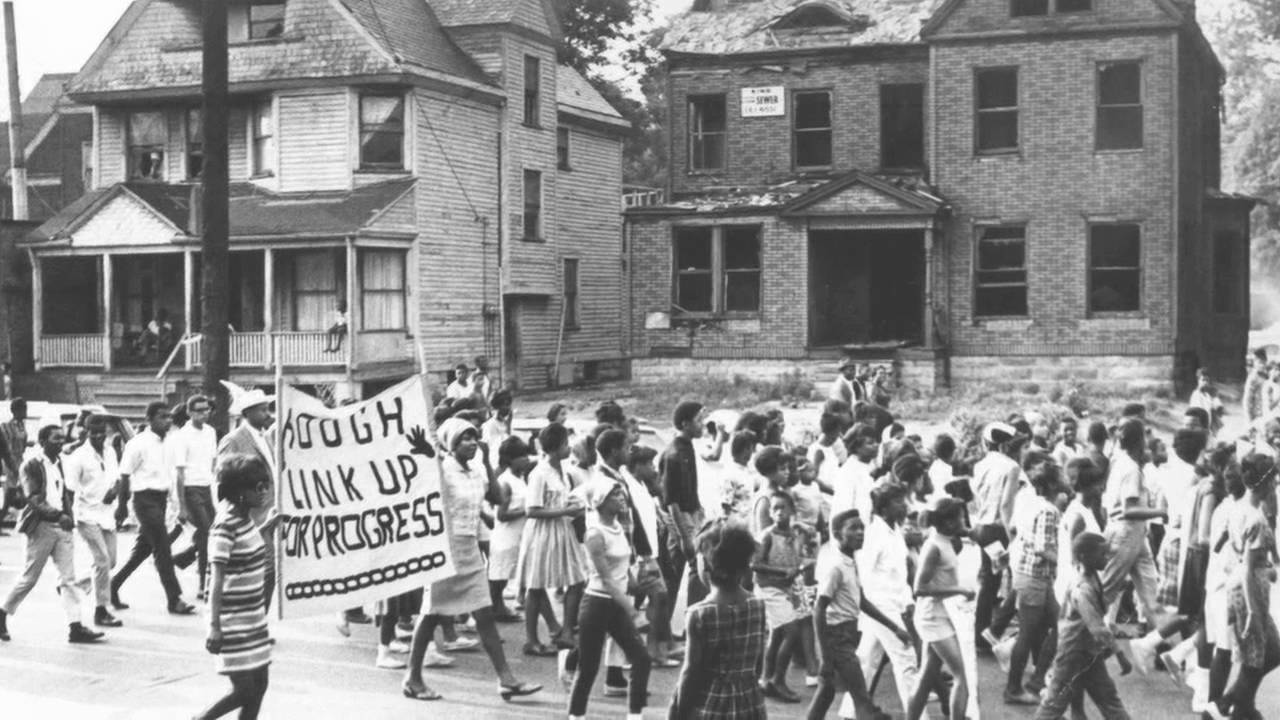
In the summer of 1966, the Hough neighborhood on Cleveland's East Side became the site of one of the most significant urban uprisings in the city's history. By that year, Hough had transformed dramatically over the preceding decade: restrictive banking and real estate practices, combined with segregated public housing placement, had pushed displaced African Americans into neighborhoods like Hough, and an influx of Black migrants from the South during the Second Great Migration accelerated the shift from a white to a Black community by 1960. By 1966, more than 66,000 people lived in Hough, nearly 90 percent of them African American. Years of substandard and overcrowded housing, discriminatory pricing by local merchants, and police harassment had left the neighborhood primed for unrest.
The unrest began on the evening of July 18, 1966, when the white owner of the Seventy-Niners Café, at Hough Avenue and East 79th Street, refused a Black customer a glass of water. As a crowd gathered outside in anger, police were unable to control the growing crowd, and rock-throwing escalated into vandalism and looting that spread through the surrounding neighborhood.
Over the next several days, Hough was gripped by vandalism, looting, arson, and gun violence, stemming from years of racial tension and discrimination against Black residents. Four African Americans were killed during the unrest, roughly 30 people were injured, close to 300 were arrested, and approximately 240 fires were set, resulting in an estimated $1 to $2 million in property damage. Mayor Ralph Locher called in over 2,000 members of the Ohio National Guard to help restore order, and although the Guard secured Hough by July 20, unrest continued to flare in nearby Black communities for several more days.
City officials, including Mayor Locher, initially claimed the riot had been planned and sustained by Black nationalist or communist organizations, a narrative reinforced when a grand jury was convened under foreman Louis B. Seltzer. Frustrated by this conclusion and the lack of supporting evidence, the Hough community organized its own citizens' investigation, led by future Congressman Louis Stokes, which found that deep-seated neglect, abuse, and disrespect toward Hough residents were the true causes of the uprising.
The uprising left a lasting mark on Cleveland. The following year, Carl Stokes was elected mayor, becoming the first African American mayor of a major U.S. city. The riots also accelerated population loss and economic decline in Hough that persisted for decades. Today, a Cleveland Civil Rights Trail marker stands at the site of the former Seventy-Niners Café, commemorating the uprising's place in the city's civil rights history.

