Download Civil Rights Tour App


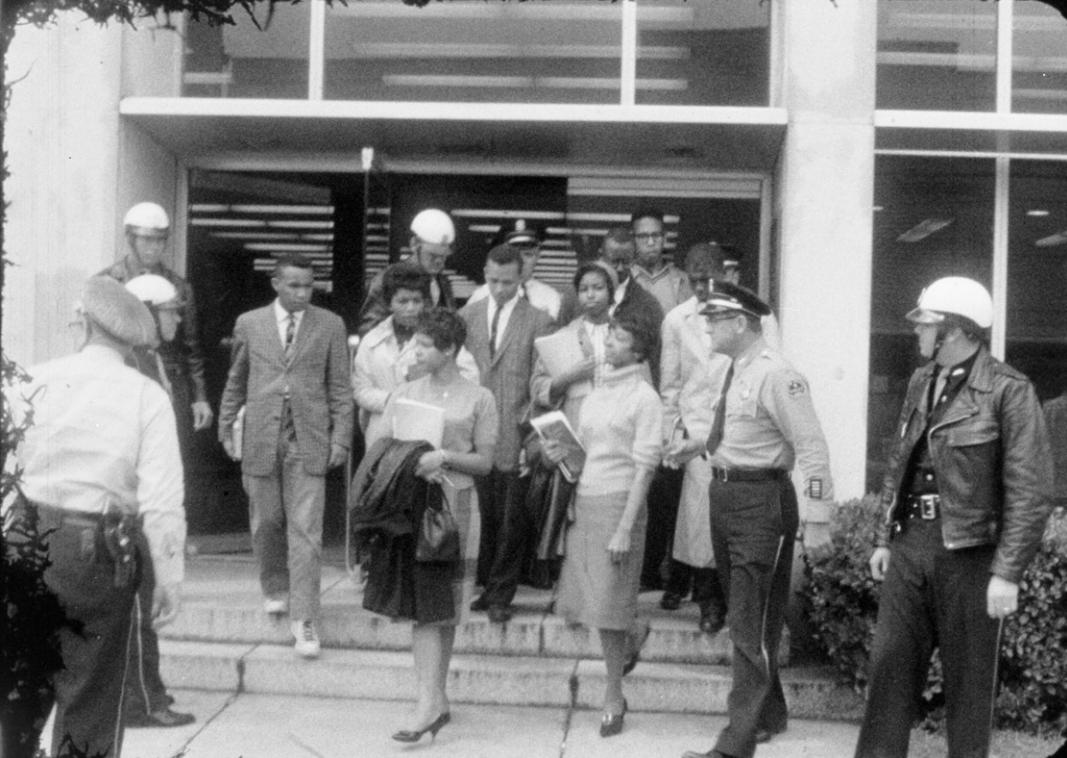
On March 27, 1961, nine African American students from Tougaloo Southern Christian College carried out a landmark nonviolent protest against racial segregation at the Jackson Municipal Library in Mississippi. Their peaceful demonstration, remembered as the Tougaloo Nine Library Read-In, helped launch a new period of student-led civil rights activism in the state.
During the Jim Crow era, public libraries in Jackson operated under racial segregation. The main municipal library at 301 North State Street served white residents, while African Americans were directed to the smaller George Washington Carver Library on North Mill Street. These separate facilities provided unequal access to books, research materials, and educational opportunities, despite being supported by public resources.
The nine students belonged to the North Jackson Youth Council of the National Association for the Advancement of Colored People. They were Meredith Coleman Anding Jr., James Cleo Bradford, Alfred Lee Cook, Jeraldine Edwards, Janice Jackson, Joseph Jackson Jr., Albert Earl Lassiter, Evelyn Pierce, and Ethel Sawyer.
Mississippi NAACP field secretary Medgar Evers helped the students organize their demonstration. They prepared through nonviolent resistance training, understanding that challenging segregation could result in arrest, intimidation, physical violence, or retaliation against their families.
On the morning of March 27, the students first visited the George Washington Carver Library and requested books unavailable at that branch. They then entered the whites-only Jackson Municipal Library, approached its catalog and reading areas, and quietly began studying.
Library employees informed the students that they were not permitted to use the facility and directed them to the segregated Black branch. The students refused to leave. Police arrived and arrested all nine for disturbing the peace.
The students were taken to the Jackson city jail, where they remained for approximately thirty-two hours. Medgar Evers arranged assistance with bail, while civil rights attorney Jack Harvey Young Sr. helped defend them.
The arrests generated demonstrations among African American students and community supporters. Jackson State College students organized prayer gatherings and protests condemning segregation and demanding the release of the Tougaloo Nine.
On the following days, demonstrators gathered in Jackson, including near the city jail and courthouse. Police used clubs, dogs, and tear gas against protesters. Several people were injured, and civil rights leader Medgar Evers was among those subjected to violence.
The Tougaloo Nine were convicted in municipal court of disturbing the peace. Each received a one-hundred-dollar fine and a thirty-day suspended jail sentence. Their punishment reflected the severe legal and political opposition confronting civil rights activists in Mississippi.
Tougaloo president Adam Daniel Beittel refused to expel the students despite pressure from white community leaders. His decision allowed them to continue their education while their demonstration gained broader public attention.
The protest did not immediately eliminate racial segregation throughout Jackson. However, it encouraged subsequent challenges to segregated public facilities, including parks, swimming pools, stores, restaurants, and other community spaces. The movement for equal library access also formed part of the broader national struggle that contributed to federal civil rights reforms during the 1960s.
Today, the original Jackson Municipal Library building remains at 301 North State Street. Constructed in 1954, it is recognized as a Mississippi Landmark and as a contributing structure within a National Register historic district.
In 2017, Mississippi installed a Freedom Trail historical marker outside the former library to honor the Tougaloo Nine and their contribution to racial equality.
Their story demonstrates that access to books, educational resources, and publicly funded institutions is an important civil rights issue. Through peaceful collective action, these nine students challenged an entrenched system of discrimination and helped advance the struggle for equal treatment under the law.