Download Civil Rights Tour App


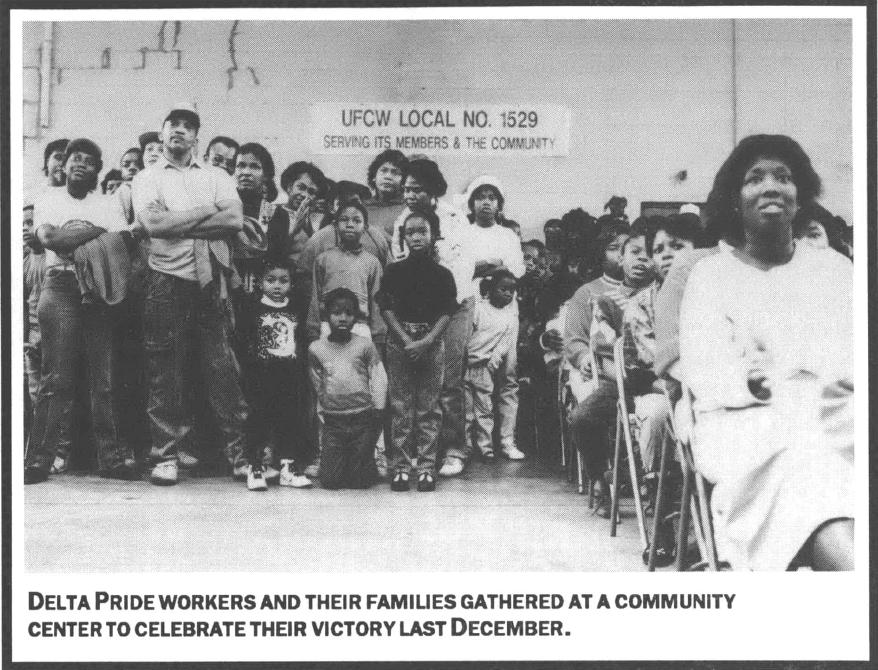
Delta Pride Catfish, a farmer-owned processing business established in 1981, grew into a major employer in the Mississippi Delta. Its processing workforce was predominantly African American women, many of whom performed rapid and repetitive cutting, gutting, and packing tasks for wages close to the federal minimum. Workers reported restricted bathroom breaks, intrusive timing by supervisors, repetitive-motion injuries, and fears of retaliation. Unionizing was difficult in Sunflower County, where limited job opportunities increased workers' dependence on the plants. After an organizing campaign led by workers, employees voted in October 1986 to join United Food and Commercial Workers (UFCW) Local 1529. Their first collective-bargaining agreement did not resolve many underlying workplace concerns.
By 1989, federal safety investigators had documented allegations of serious ergonomic hazards and inadequate reporting of injuries at Delta Pride. As the union contract expired in 1990, negotiations over wages, safety, and employee treatment deteriorated. According to the Mississippi Encyclopedia, workers rejected a proposed 6.5-cent hourly wage increase by 410 votes to 5 on September 10. More than 900 employees walked out in mid-September at Indianola and an associated Inverness-area operation. Contemporary newspapers report September 12 as the beginning; the Encyclopedia reports September 13. The event is therefore best dated September 12–13 through mid-December 1990 rather than assigned one uncontested start date.
The strike's leadership and public identity depended heavily on Black women workers. Sarah White, Rose Turner, and Mary Young were among the organizers who appealed to churches, civil rights groups, labor allies, and other communities for support. Picketers sought to discourage replacement workers from crossing the line while the union organized groceries, financial relief, travel, and a national boycott of Delta Pride products. Civil rights supporters, including NAACP affiliates and advocates for economic equality, emphasized connections between workplace power and the region's longer history of racial discrimination. Management disputed the characterization of its practices and continued some production with replacement workers.
Public pressure and renewed bargaining led to a settlement in December. The Mississippi Encyclopedia dates an agreement to December 12 and describes a 60-cent hourly raise for eligible workers, recall provisions, and a joint health-and-safety committee. Contemporary United Press International reporting records union ratification on Friday, December 14, 1990, by 399 votes to 1; the Encyclopedia instead reports ratification on December 13 by 479 votes to 1. These accounts differ and should not be silently combined. The broad outcome—a ratified contract, improved pay, safety oversight, and provisions for returning strikers—is consistently documented. A separate federal OSHA settlement in June 1991 addressed hazardous conditions at several Delta Pride locations; it should not be mistaken for the December 1990 labor contract.
The strike offered a prominent example of workers linking civil rights to workplace dignity and economic opportunity. Victory did not resolve every dispute, and later layoffs and additional organizing challenges followed. Its importance lies in the capacity of predominantly Black women food-processing workers to organize collectively, insist on safer conditions, and attract national solidarity. The original Indianola main plant is documented in a 1991 federal filing as being on Indianola Industrial Park Road; the exact surviving building and 1990 picket-line positions are not verified. The settlement also references the Inverness/Delta South operation but its address appendix lists Highway 49 West South under Indianola, an archival inconsistency requiring caution.