
Download Civil Rights Tour App


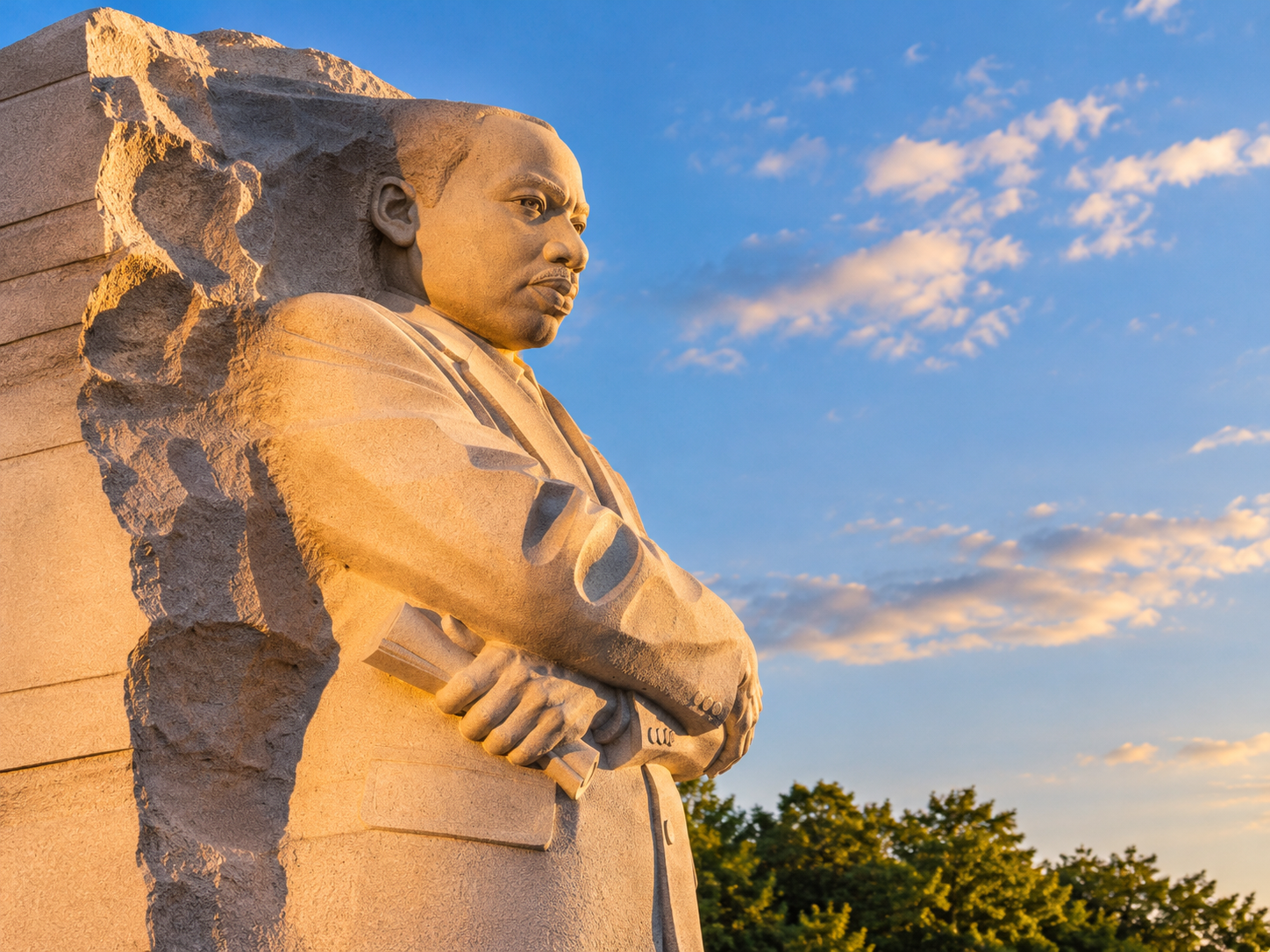
The Martin Luther King Jr. Memorial stands in West Potomac Park on the National Mall in Washington, DC, near the Tidal Basin. It honors Dr. Martin Luther King Jr., the Baptist minister and civil rights leader whose commitment to nonviolent action helped reshape the United States. The address, 1964 Independence Avenue SW, refers to the year the Civil Rights Act became law. The memorial invites visitors to consider how people, working together, can challenge discrimination and extend the promises of American democracy.
Born in Atlanta, Georgia, in 1929, King studied at Morehouse College, Crozer Theological Seminary, and Boston University. In 1954, he became pastor of Dexter Avenue Baptist Church in Montgomery, Alabama. After Rosa Parks was arrested in December 1955, local Black residents organized a boycott of the city’s segregated buses. The Montgomery Improvement Association chose King as its president, and the boycott continued for more than a year. Its success helped establish mass, nonviolent protest as a powerful means of pursuing civil rights.
King’s approach drew on Christian ethics, the philosophy of nonviolence associated with Mahatma Gandhi, and the work of fellow organizers and advisers, including Bayard Rustin. He helped found the Southern Christian Leadership Conference in 1957 and supported campaigns against racial segregation in cities across the South. In 1963, his “Letter from Birmingham Jail” defended direct action against injustice. Later that year, at the March on Washington for Jobs and Freedom, he delivered the “I Have a Dream” speech near the Lincoln Memorial. His leadership contributed to national attention and pressure for the landmark civil rights legislation of the 1960s.
In 1964, King received the Nobel Peace Prize. He continued to advocate for voting rights, economic justice, and peace before his assassination in Memphis in 1968. His achievements were shared with thousands of organizers, volunteers, students, religious leaders, and community members who risked their safety to oppose racial discrimination. The memorial recognizes both King’s leadership and the broader movement that made progress possible.
The memorial’s central artwork expresses this struggle in stone. A roughly 30-foot likeness of King, holding a rolled set of papers, emerges from the Stone of Hope, which appears to have been pulled from the larger Mountain of Despair. The concept draws on a phrase from his 1963 speech about bringing hope out of despair. Curving walls feature excerpts from his sermons, speeches, and writings. The site’s position between the Lincoln and Jefferson memorials connects King’s vision to the continuing national debate over freedom and equality. Opened to the public in August 2011 and formally dedicated that October, the memorial encourages visitors to turn remembrance into civic responsibility.